
The Secret Agent
A toast to everyone here, especially to this brilliantly bizarre movie.


When Marcelo Alves (Wagner Moura) pulls into a petrol station at the start of The Secret Agent, he is immediately confronted with a rotting corpse that’s just lying out there in the open. Oh don’t worry about it, says the attendant; the dead guy was just a would-be robber and he’s been there for days, awaiting some cops to show up and do their job. Anyway, how much petrol would you like?
When a couple of cops rock up minutes later, almost serendipitously, they ignore the body and immediately start questioning Marcelo before searching his car. The air is thick with menacing tension, but he is eventually allowed to go free after bribing the cops with some cigarettes. You immediately clock that while this guy fits the ‘secret’ part of the movie’s title, he is definitely not an agent, secret or otherwise. There’s clearly more to Marcelo than meets the eye, but would he actually fight back had things gone sideways with the cops? You’re not entirely sure.
1977 Brazil was a dark time in its history as the country was in the grips of a military dictatorship, and it’s clear that encountering corrupt cops who would shake down a stranger rather than investigate a corpse is simply part of the norm of the period. This masterful 10-minute sequence showcases much of the movie’s setting, tone, and how its protagonist fits in this weird, almost nightmarish world through tension-inducing action and reaction rather than exposition.
Director and writer Kleber Mendonça Filho unfolds The Secret Agent from the lens of someone using this period of Brazilian history as a backdrop for an open-ended playground rather than a simple rehashing of a Wikipedia page. It is perhaps the year’s most unrestrained movie, filled with richly layered characters who capture your attention due to their integrity (or lack thereof). This is also one of the most bizarre movies of the year. I don’t think I’ve watched a movie all year quite like this one where it demands that you be on its wavelength to fully work.
The Secret Agent is an overwhelming 161-minute concoction of several different movies blended together. It is a Brazilian political thriller that inadvertently functions as a perfect companion piece to Paul Thomas Anderson’s pulsating One Battle After Another; it is a deeply sincere and, at times, funny movie about a painful time in a country’s history like Jafar Panahi’s It Was Just An Accident; it occasionally masquerades as a loose hangout movie filled with Richard Linklater-esque characters whom you just want to have a beer with; and there are several moments where it is an absurd piece of schlocky but effective bloody grindhouse fare from Sam Raimi, right down to a subplot involving a murder victim’s rotting dismembered leg.
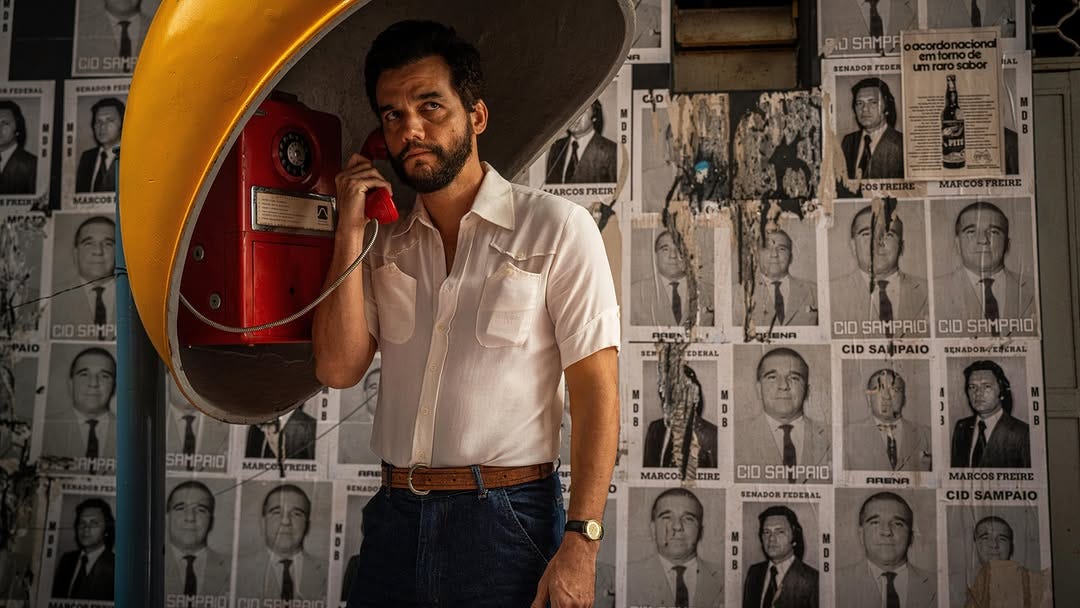
There is a lot going on in The Secret Agent and this is where your mileage may vary. It can feel self-indulgent and disjointed to some. To others, it can feel like a beautiful snapshot of a country in turmoil. The one undeniable thing though is just how distinctively gorgeous this movie is. Filho leans hard into the grainy 70s aesthetic and combines it with some of the best production design you’ll ever see on a big (or small) screen. Architectural exteriors, interior decorations, and the imperfect background actors with crooked teeth all scream ‘period piece’ in an honest way. Everything and everyone is a bit raw, dirty, sweaty, and even a touch sexy on occasion. This isn’t Filho showing off. This is a director using whatever is available to him to depict nostalgia in a positive light during a grim period.
The Secret Agent is made by someone who unabashedly loves movies and is unafraid to put his influences front and centre. Quentin Tarantino would be impressed and envious at what Filho has created here, right down to the movie’s three-chapter (complete with title cards) structure. Like Tarantino, this movie functions less like a structured story and more like a series of linked vignettes, which can make it feel a bit tonally disjointed as story strands are floating all over the place like carnival confetti, with seemingly very little to tie them all together.
When Marcelo reaches his hometown of Recife and makes his way to an apartment building owned by Dona Sebastiana (Tânia Maria), a fiery 77-year-old radical whom I would love to hang out with forever, more pieces of the story are slowly put on the board. We are introduced to the gang of refugees also hiding out, such as a single mother named Claudia (Hermila Guedes) and a fascinating couple fleeing from Angola whose real names are never revealed. Just like how the production design pulls us into this world textually, this rich cast of supporting characters all feel interesting and can easily carry their own movie. We don’t learn much about them, but their presence serves as a reminder that there are many others who are trying to survive this brutal world, not just Marcelo. History is ultimately written by the victors and there are many of these little stories of revolution and survival that fall through the cracks.
Perhaps more importantly for us, we gradually learn about Marcelo’s background, his true identity, why he’s on the run, and how he is ultimately just a father trying to do right by his young son, Fernando (Enzio Nunes). The Secret Agent takes its time to reveal these details to us, seemingly to convey the storm that’s slowly brewing around Marcelo, yet Moura’s deceptively subtle performance gives the character a grounding sense of controlled calm within the chaos.
Every now and again, you see glimpses of something underneath Marcelo’s cool and charismatic demeanour - like when he wanders into some Carnival celebrations after a day packed with intense encounters and finally lets himself have just a little bit of fun. Moura drip-feeds us his inherent magnetism, almost deliberately, until the final moments where his whole performance snaps into place like a detective putting all the pieces together to solve the mystery. In a year with some all-time great leading male performances, Moura stands out with a distinct lack of exuberance.
When the second half of the movie begins, the various story strands start to tighten up and the full picture begins to form. The seemingly endless parade of assassins, revolutionaries, investigators, and random one-off characters, which includes a German Jewish Holocaust survivor, are snapped into focus within the wider story. This is the payoff to getting on Filho’s wavelength during the leisurely first half. If you’ve made it to the midpoint, you’re in for a hell of a climax. What initially seemed like weird subplots suddenly slot into the main story neatly without sacrificing any thematic depth for plot reasons.
Take the aforementioned rotten leg side-story as an example. This weird little aside serves as a stepping stone for corrupt local police chief Euclides (Robério Diógenes) to get involved in Marcelo’s story while also functioning as an absurd yet funny critique of misinformation, censorship, and the manipulation of the Brazilian press at the time (which is very prescient given what we’re going through in the present day with social media and journalists being increasingly hampered).
Filho fills this movie to the brim with aesthetic imagination, bitter critiques of 1970s Brazil, and humanistic stories, but there’s a distinct lack of catharsis. Tying up all the aforementioned story strands is not high up on Filho’s list of priorities for this movie. Whereas One Battle After Another is controlled and cohesive, The Secret Agent is downright messy in comparison. While some answers remain out of reach and can feel downright unsatisfying, there are several sequences that are among 2025’s best, such as a flashback sequence involving Marcelo and his wife having a tense dinner with an abhorrent person who ultimately sets this movie’s events in motion. In an interesting way, this is a movie where the whole is just as good as the sum of its parts.
As The Secret Agent propels itself towards its bittersweet ending, there’s a moment of respite in which all the refugees under Dona Sebastiana’s roof just hang out one final time. As she makes a toast, she drops a pointed comment about Brazil and its people, saying, “life goes on, and I wanna say you guys have made me happy, just keep that in mind. This shit will pass, y'hear?” For a movie that doesn’t give us that many cathartic moments, it refuses to let evil prevail while understanding that defeating these oppressive forces will be exceedingly difficult. Given how Brazil has managed to do the seemingly impossible by jailing its former far-right leader Jair Bolsonaro for 27 years for attempting a coup, it makes perfect sense why Kleber Mendonça Filho manages to find hope among the dark. In using memory and nostalgia to reclaim history in some form, there’s every reason to keep fighting and to never forget what’s at stake.