
Blue Moon
Nobody ever loved me that much... but I definitely loved this movie.


Mild spoilers ahead, so keep On Your Toes.
We’ve all met someone or had a friend like Lorenz Hart (Ethan Hawke) who’s as charmingly witty as he is annoying. You know, the type who would perhaps drink too much and talk your ear off, occasionally repeating the same story over and over again. You let it slide, though, like bartender Eddie (Bobby Cannavale) does for Hart, because the guy is ultimately harmless and maybe just needs someone to chat to. Not with. Important distinction.
For Hart, talking is all he’s got left. As the opening scene tells us right away, the evening that unfolds in Blue Moon is the last time he gets to talk in a noteworthy way. This isn’t a deification or a tribute, but more a cautionary tale.
Taking place primarily at the legendary Sardi’s bar on Broadway, Blue Moon follows Hart on the opening night of the mega-popular musical Oklahoma!, written by his former writing partner Richard Rodgers (Andrew Scott) and Rodgers’ new colleague Oscar Hammerstein II (Simon Delaney). For Hart, this is like seeing your ex with a new partner and looking happier than ever. It gnaws away at him, and watching Hart slowly lose it while holding court with the bar’s patrons as he waits for Rodgers to turn up is tragically relatable.
It starts charmingly enough when Hart walks into Sardi’s and exchanges lines from Casablanca with Eddie. Hart is particularly fond of the “no one ever loved me that much” line. Things quickly go downhill, though. When Hart rhetorically asks himself “am I bitter?” (“fuck yes!” he is), it’s not entirely just envy because his admittedly-biased critique of Oklahoma! is somewhat valid. Why does the title even need an exclamation point?
As Blue Moon is a classic ‘single-location’ movie, the whole thing lives or dies on the strength of the characters and script, since there’s limited scope in what director Richard Linklater can do visually. Screenwriter Robert Kaplow’s script is not only a fantastic showcase of Trojan-horsing chunks of exposition into a movie in interesting ways, but it messes around with the typical biopic structure in unorthodox ways. Kaplow and Linklater aren’t particularly concerned with real events or finding positives in Hart’s life, opting to find ways to show the man’s flaws and penchant for self-sabotage over the course of one (fictionalised) evening. That Linklater trademark compressed time frame fits perfectly for the intimate story being told in Blue Moon.
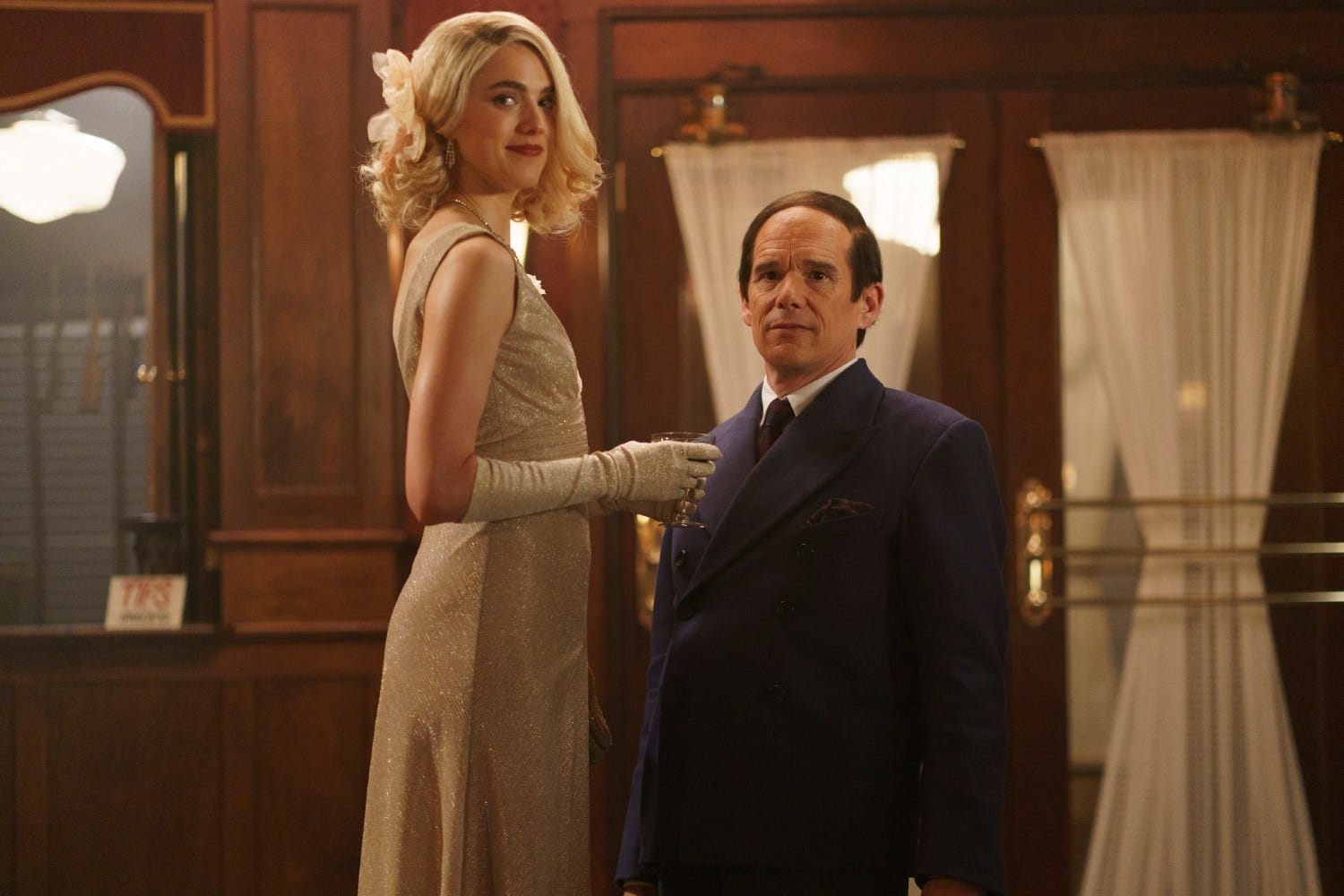
When Hart talks to Eddie about his infatuation with 20-year-old college student Elizabeth (Margaret Qualley), it’s like listening to a 15-year-old teenager telling his friends about his new ‘girlfriend’. He evades Eddie’s repeated questions about whether he’s slept with Elizabeth by dressing up the truth with ribbons of flowery metaphors and the omission of certain details. You’d think she’s Helen of Troy with how she’s described.
Hart speaks almost entirely in dense monologues throughout Blue Moon, but the longer he talks the quicker he loses grasp of the story he’s weaving. We quickly deduce that this is a one-sided infatuation and it’s clear Elizabeth is using Hart primarily for his Broadway connections. Is he aware of this or does he truly believe that she loves him?
After having Hart talk up a big game throughout act one of Blue Moon, the movie hits a new peak when Rodgers and Elizabeth arrive at Sardi’s. The vibe between Hart and Rodgers is initially respectful, if somewhat awkward. Not unlike meeting your ex again. Rodgers has moved on and he shows remarkable patience as Hart’s bitterness slowly slips through the cracks, ultimately culminating with him throwing a lifeline to Hart by offering to collaborate on a revival of one of their earlier shows. There’s still love there, but the gradual incompatibility has become too much to overcome.
When there’s that glimmer of hope, all common sense goes out the window. Hart grasps it with both hands and starts pitching his former partner new musical ideas (which sound awful). He still genuinely believes he and Rodgers can go back to working like they did previously and recapture the ‘glory days’ as they were. We all know it won’t happen, yet Hart is the only one who does. All the Rodgers and Hart scenes are an S-tier showcase of faux sincerity and depressing delusion. It’s never going to end well, yet Hart refuses to see it and is stubbornly clinging onto past successes rather than his reality of being a washed up genius.
The contrast between Hart’s flagging career at this point during the events of Blue Moon and Linklater’s own career trajectory - he’s in a third period of acclaim and productivity - is fascinating in what the prolific director has to say about relevance and knowing your place in the world. Having outlived Hart by nearly two decades and gone through his own ups and downs, Linklater brings a much-needed level of self-awareness to the material. Hart may not recognise his place in the world (or perhaps refuses to acknowledge it), but the world around him does. Having E.B. White and Eddie chat about Hart and the tale he’s woven is quite amusing, yet melancholic.
Things take a turn for the worse for Hart when Elizabeth enters the picture and the pair get into a long one-sided D&M about her love life while he listens patiently and with empathy. As gut-wrenching as this sequence is, what’s interesting is it eschews the typical ‘friend zone’ conclusion for a more interesting dive into Hart’s desperation for human connection.
There are occasional hints about Hart’s sexuality throughout Blue Moon, but Linklater cares less about which side of the stage he dances on than how this affects his relationships. When Elizabeth tells Hart she doesn’t “love him in that way”, you get the sense that the actual consummation part matters less to him than her role in his life emotionally. Maybe he’s aware that she’s using him, but that’s okay because it’s still a way he can be close to her. This is where Hawke’s performance really sells the complexity of what’s going on in Lorenz Hart’s head.
In the hands of someone less attuned to Linklater’s sensibility, Hart could come off as comical and downright unlikeable. But Hawke is the perfect fit for the character as he’s a very eloquent talker who knows how to operate on Linklater’s wavelength (this is their ninth movie together). What’s interesting is watching Hawke operate in rare ‘uncool loser who can’t get the girl’ territory. He dons a foppish comb-over hairpiece on his shaved head, wears a heap of makeup, and stands at least 30cm shorter than everyone else and is forced to look up at people. But because he’s ‘Ethan Hawke’, there’s a level of self-awareness to the Hart performance that prevents it from being pure despair. 2025 has seen a heap of all-time great male movie lead performances, including a stoner idiot, a table tennis-playing scamp, and a pair of vampire-fighting twins in the 1930s, but I’d argue Hawke’s subtle yet impactful work as Hart may well be the year’s best.
The final few moments of Blue Moon are borderline heartbreaking, though not surprising. We know that because of the movie’s opening scene, which makes the near-real-time unfolding of events even more poignant and tragic. Linklater’s management of time is second to none. Since no one has ever loved Hart that much, this movie does all it can to show him that there are those out there who do indeed adore him in their own way.
It’s fitting that Blue Moon is named after one of Lorenz Hart’s most famous songs, yet it is one he despised. While he may not like the song itself, Richard Linklater has put together a fantastic movie that shines a light on the man better than any ‘normal’ biopic will. Hart would probably hate this movie, and that’s the highest praise one can give it.