
Sinners
The Devil went down to the Mississippi Delta.

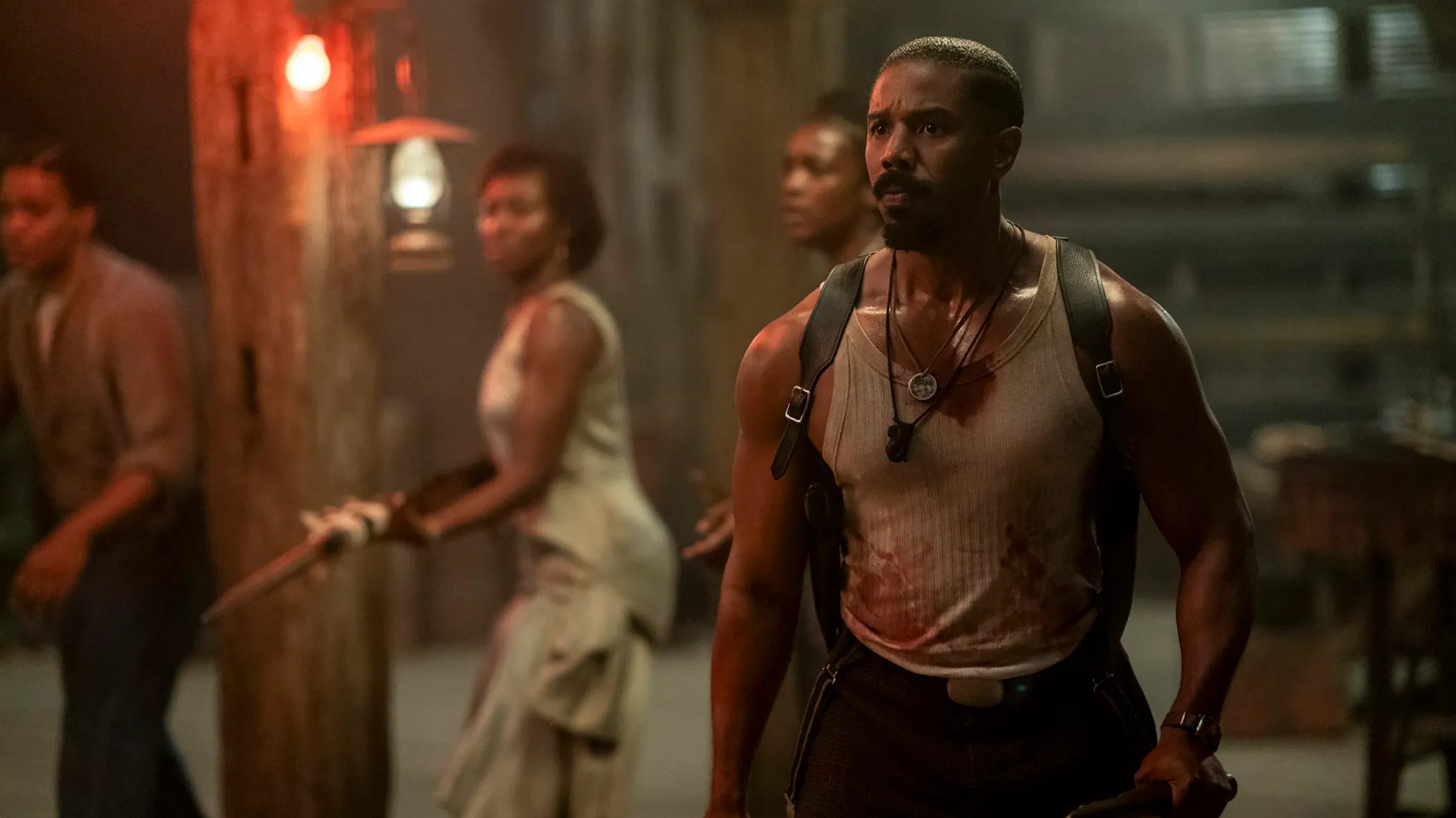

Audacious.
That word rang in my head from minute one of Sinners right until the post-credits scene.
Having rewatched all of Ryan Coogler’s filmography in preparation for Sinners, I was struck by its familiarity to his previous work while having any notion of what to expect from a ‘Ryan Coogler’ film shattered.
There’s an abundance of weighty themes like racial tensions in America, Black families, Black resiliance, and Black culture.
There’s slick filmmaking and craft that’s up there as the very best in the business today.
There’s Michael B. Jordan, this time playing Smoke and Stack, bootlegging twins and former soldiers who fought in World War I before working for Al Capone’s outfit in Chicago.
And yet, Coogler has taken all those familiar pieces, combined them with some classic movie genre tropes, and took such a wild swing that it’s made a strong case as one of 2025’s best films.
Sinners kicks off with Smoke and Stack returning home to the Mississippi Delta with crates of Irish beer (stolen from Capone, implied), rolls of cash (also stolen, implied), and a goal to open a juke joint at the old sawmill they just bought off a racist white man (definitely KKK, no implication there).
It’s obvious early on that Sinners isn’t a movie made for me (an Australian-Chinese guy who redefines the word ‘pale’) per se. Yet there’s plenty of meaty stuff to sink my teeth into. This was by design as Cooger has stated that he made Sinners as both a tribute to his uncle and to the power of cinema. This is a testament to Coogler’s tightly structured and well-written script.
The first hour essentially functions like the first act of a heist movie. New characters are introduced, past histories are hinted at, their roles at Smoke and Stack’s planned juke joint are laid out clearly, and you’re left wondering “so what’s going to happen next?”
The thematic weight underpinning Sinners is there if you want to dig it up. But I also just wanted to know who each of these characters are and what exactly they mean to Smoke and Stack. Why is Mary (an underused but great Hailee Steinfeld) pissed off at Stack? What’s up with Annie (a fantastic Wunmi Mosaku) and Smoke? Who are those Chinese shopkeepers (Li Jun Li and Yao, both brilliant) and what’s their deal?
But of all these characters, the movie hinges on one crucial person and it isn’t Jordan despite his top billing. That honour belongs to newcomer Miles Caton, who plays Smoke and Stack’s cousin Sammie Moore and is a talented musician in his own right. There’s a lot of pressure on Caton as not only is he having to hold his own against some heavyweight actors like Steinfeld and Jordan (twice), but he needs to convince us that he is an absolute blues God whose picking skills is far better suited to a guitar than the cotton fields of a Jim Crow-era Mississippi Delta.
That Caton manages to do so with aplomb is a pleasant surprise and the generous spotlighting of his genuine guitar skills leads into the most ridiculous and dizzying scene of the whole movie - perhaps of the whole year.
Coogler takes the idea that Delta-blues music is so transcendentally powerful it’s a portal that links musicians and dancers from all eras. Artists past and present circle around Sammie in a dizzying acid trip of a ballet, his performance is so arresting that he shines as the north star for what music means to those in the Mississippi Delta.
How the hell Coogler pulled what was in his head and put it all on the big screen in such an audacious way I’ll never know. It’s crazy. It's cinematic ecstasy. It’s a little campy even. All I can say is that that scene in IMAX is worth the price of admission alone.
I suppose I should talk about the vampire stuff at this point. The worldbuilding and characters of Sinners is so strong that I had completely forgotten that this movie was marketed as a blood-sucking good time, until Jack O’Connell stumbles into frame as the movie’s daylight-allergic antagonist, Remmick. He’s charming, he’s manipulative, he can dance and sing, and he just wants to suck Sammie’s blood. If it means taking down Smoke and Stack’s newly minted juke joint and all those inside, then so be it.
Coogler doesn’t reinvent or subvert any traditional vampire tropes in Sinners, but he uses Remmick as the yang to Sammie’s yin. The Devil went down to the Mississippi Delta not to wreak havoc (though there’s plenty of that) but to essentially assimilate Sammie (i.e Black culture) into vampirism (i.e white folk), quite literally. It’s a clumsy yet fascinating metaphor because rather than paint vampires as “them evil white folk”, Coogler makes Remmick’s vision genuinely tempting. I certainly didn’t expect vampires dancing an Irish jig to be so creepy yet weirdly fun. Then again, a white Irish Devil works in mysterious ways when facing off against a Black blues God.
When I walked out of the IMAX cinema, that exhilarating two-hour rollercoaster thrill was replaced with deep mulling over the concerns that Coogler is trying to express. Or maybe it was still trying to figure out how Coogler pulled off that bonkers Sammie performance set piece.
Sinners leaves it up to you to ponder the big questions. But in equal measure, it just wants you to have a good time, pondering be damned if you want to brain rot. And boy did I have a good time.