
Backrooms
It's like... describing a great movie to an alien, and then asking the alien to make that movie purely from memory.


A hazmat suit-clad man with a duffle bag of discs is running through seemingly never-ending office spaces. He’s got a 1990s camcorder, and his breath is ragged. As we watch him check and recheck every corner from the perspective of the camcorder, the sense of unease rises exponentially. The handheld camerawork is getting shakier, and the random noises echoing from one of the many hallways are getting louder. You can’t tell if there’s another character or if the office rooms are the character, but the man’s clearly running from… something. Stumbling upon a radio, he desperately calls for help. His — and our — heart rates are spiking now… and all that tension is released in one brilliant payoff as ‘Backrooms’ is splashed across the screen.
What is going on with these creepypasta-esque office rooms with the pale yellow walls and flickering fluorescent lights? Why is the man in a hazmat suit? Why was he even there? What was he running from? So much intrigue and world-building in just the opening 10 or so minutes.
Had Backrooms left it there, it would’ve been a triumphant short film that made the haphazardly-shot handicam aesthetic cool again, elevated what made the original series of viral YouTube videos special, and left a visceral impact upon audiences’ heart rates. But alas, 10 minutes does not a movie make. The remaining 100 minutes are a mixed bag of thrilling liminal visuals, solid acting, and some utterly baffling narrative and creative choices from first-time director Kane Parsons.
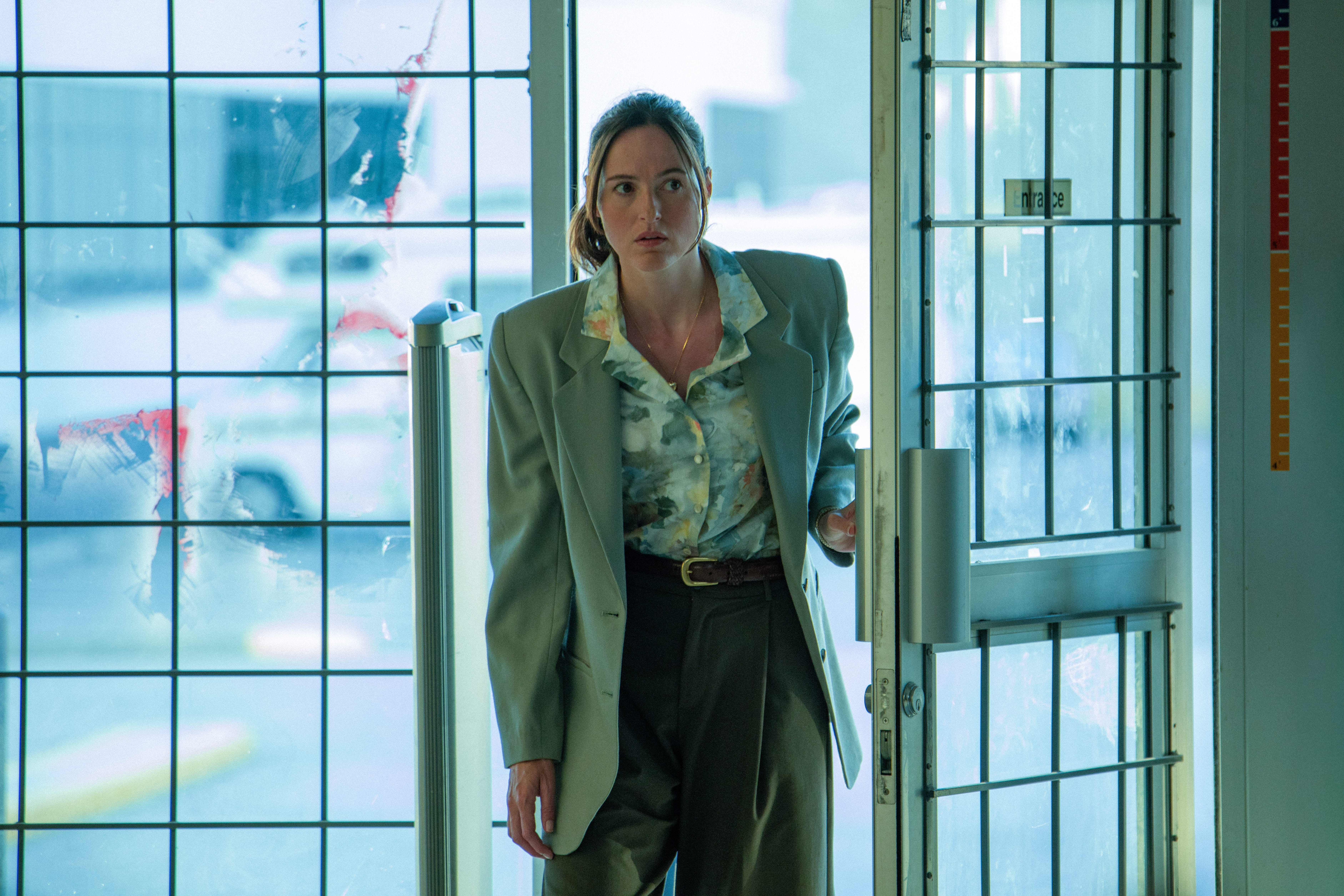
We’re introduced to Clark (Chiwetel Ejiofor), a failed architect turned failing furniture store owner who is reluctantly receiving treatment from a therapist, Dr. Mary Kine (Renate Reinsve). There’s a crackle of electricity whenever these two share the screen because he doesn’t want to be there, and she’s just trying to do her job. We’re not sure how this relates to the backrooms, but it is compelling for now. That crackle turns into lightning when Mary makes Clark do a role-play exercise, and he completely unloads all his frustrations while she bats away his aggression with more probing questions, delivered with icy chill. Verbal tennis at its finest.
There’s no time to explore all that potentially meaty internal Clark stuff, though, because there’s a plot to unfold. Self-improvement can wait, but the interdimensional portal at work leading to some never-ending office rooms with pale yellow walls and flickering fluorescent lights can’t.
In theory, shoving Clark into the backrooms is a recipe for fireworks. The first time he enters this funhouse mirror world built out of mundane everyday items, there’s a palpable dread in the air. We know he’s walking into danger, and he doesn’t even have a hazmat suit. What chance does he have?
Ejiofor does a great job internalising Clark’s issues without giving off too much of a ‘toxic man’ vibe, and his fear upon discovering the backrooms for the first time is truly gripping. But the longer we follow Clark as he explores the backrooms, the underlying foundation of the character becomes shakier and more reliant on Ejiofor’s talent. Screenwriter Will Soodik’s script basically shoves Clark’s characterisation to the side until it is required again, which makes you wonder what the whole point of his existence is. From about the midpoint onward, the movie is on a slippery slope and losing the immense amount of goodwill it’s built up so far.
Horror movies work well by either withholding answers in order to let audiences bask in the mystique of the established universe (like Sinners), or providing intriguing answers that recontextualise everything that’s unfolded (like Weapons). Backrooms tries to give some answers and maintain some mystery for the audience, and succeeds at neither.
When Clark is back in the backrooms with his employees, Bobby (Finn Bennett) and Kat (Lukita Maxwell), some of the impact has already been lost. The handheld camerawork, the flickering lights, and the creepy sound effects are still all there, but the gap between visuals and storytelling is widening. The world has been built, and we’re learning nothing new. Instead, we’re left with short-lived shock value that fades away as quickly as it appears.
More worryingly, it becomes increasingly clear that Parsons isn’t withholding answers because of some grand reveal that will link everything together like a perfectly crafted ballad. Rather, it’s because he isn’t entirely sure where Backrooms is going, thematically and dramatically. When you’re repeating the same monologues multiple times, sometimes as dialogue and sometimes as a voiceover, it screams a lack of confidence in the storytelling.
The most consistent idea Parsons has is about how memories can be unreliable, and details can warp over time until barely anything resembling the original is left. It’s perhaps the strongest thematic element that complements the bizarro construction of the backrooms universe. Melting couches and household items blending into the floor only makes sense in dreams or twisted memories.
Putting the onus on the audience to piece together something like this is part of the fun, and had Parsons left it at that, the simplicity would’ve strengthened the thematic spine of Backrooms. But he just had to throw some extra stuff — like half-baked ideas about mental illness and alternative dimensions — because, well, why not? It’s almost like Parsons isn’t quite sure which idea works best, so might as well throw them all in. Of all the ideas thrown at the wall, though, the most egregious is Mary’s backstory.
Whereas Reinsve puts on a tour de force of barely controlled emotion in Sentimental Value, the icy control shown in Backrooms is less of a ‘there’s a lot going on under there’ and more of a ‘doing the best she could with a barely-there character’ sort. How child Mary grows up to adult Mary is fuzzy at best, as there’s little to no context for why the scenes play out the way they do and how they relate to the overarching story in Backrooms. Considering that Parsons’ mother is a therapist and Mary’s strongest scenes are her therapy sessions with Clark, it may simply be that he couldn’t quite figure out the rest of the character beyond her office.
Ultimately, the fatal flaw of Backrooms lies in the underdeveloped relationship between Clark and Mary. We don’t see them interact in any shape or form outside of her office, nor do their backstories add any meaningful context or narrative weight to the story. When several of the big character decisions that lead to the series of events in the movie’s second hour unfold, it is all frustratingly perplexing because the movie’s logic crumbles at the slightest bit of scrutiny. There is simply no rhyme or reason for either character to do what they do or to even be involved in this particular narrative.
When the third act kicks off, almost all the mystique is gone. An attempt to push the stakes even higher inadvertently results in a pretty generic horror movie climax that’s a far cry from the gripping opening 10 minutes. As Backrooms drops its final provocative image, almost seemingly in premature triumph, I’m left underwhelmed rather than impressed. This wasn’t a successful tying together of loose ends. It was a Hail Mary (pun intended) play where Parsons throws something at the audience and hopes they can come up with a good answer because he sure as hell wouldn’t. Or more likely couldn’t.
It’s a shame because there are several moments where Backrooms is incredibly fun and features some of the best horror stuff that’s been put on the big screen in a while. Kane Parsons is undoubtedly talented and full of some great ideas, but his undercooked storytelling falls considerably short of his visual flair. He may have packed a lot of stuff into a feature-length movie, but there’s only a YouTube clip’s worth of material that’s of any actual substance.