
The Invite
Just to be clear, you, you, her, me... and this messy yet enjoyable romp.

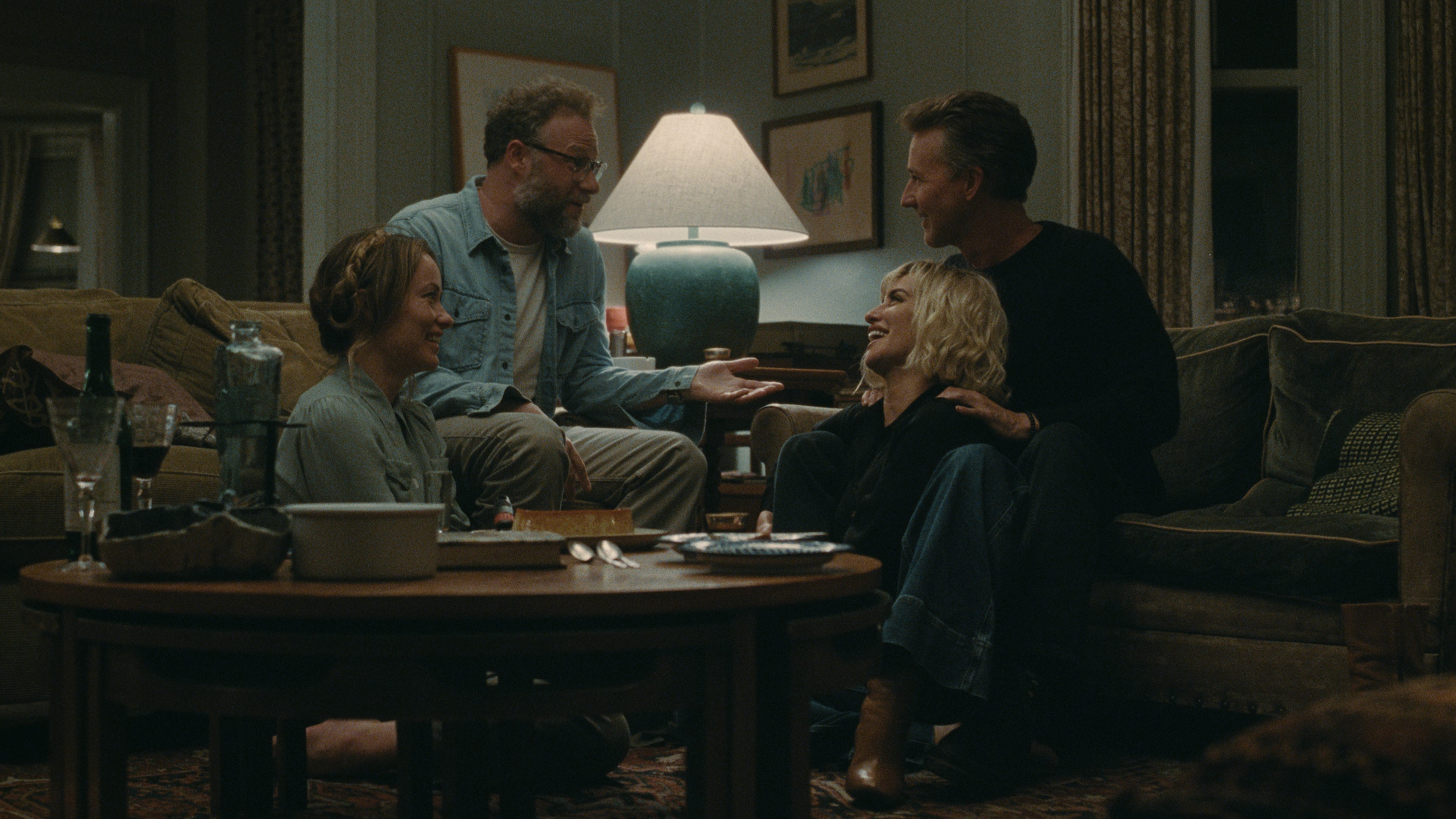

I don’t know if I’d invite my neighbours over to hang if they were keeping me up late at night with their animalistic, wall-thumping love life. Then again, I’m not stricken with anxiety-driven control issues like Angela (Olivia Wilde, pulling double duty as director and lead), nor am I in a perpetual state of ‘unfiltered and over everything’ that her husband, Joe (Seth Rogen), embodies. So when The Invite opens with Oscar Wilde’s classic epigraph, ‘One should always be in love. That is the reason one should never marry,’ and then cuts to the couple arguing mere minutes later, it is setting up high expectations for the rollercoaster this messy pairing will endure for the next 107 minutes.
And you know what, it is an extremely fun rollercoaster despite the occasional uncomfortable bump.
Joe and Angela are clearly unhappy, yet there’s a spark underneath the tension. Rogen and Wilde make hay with Will McCormack and Rashida Jones’ rapid-fire script, throwing well-written zingers with such rhythm that there’s still love underneath the hostility. The movie also pulls no punches in depicting both Joe and Angela as incredibly annoying people, but the script is smart in justifying why they’re acting so petty to each other. I’d be mad at Joe for forgetting to get the wine, but I’d also be mad at Angela for texting me that request when I’m 10 minutes from home, pedalling away on my fold-up bike while my back is aching and I can’t answer my phone.
By the time the neighbours, Pina (Penélope Cruz) and Hawk (Edward Norton), finally arrive, fuel is thrown on the fire. When Hawk politely asks whether he should take his shoes off, lest he scuff the newly installed floorboards, Joe’s pointed ‘I don’t give a fuck if you take your shoes off’ pushes the tension even higher. Everything is going to descend into glorious chaos; the question is how.
Since The Invite is basically an extended bottle episode set in a gorgeous apartment, Wilde makes several creative choices that keep proceedings from feeling claustrophobic or boring. The physical distance between character pairings varies depending on their current vibe. Pina and Angela immediately click and are often right next to each other in close-up. Joe hates Hawk’s guts and the two men are rarely in the same shot alone. When Angela and Joe are at their angriest with each other, they’re positioned on opposite ends of the frame with a chasm of dead air between them, or isolated by the various IKEA-bought wall mirrors.
But the most effective element of The Invite is its four lead actors, all of whom understood the assignment and brought their A-game — and respective baggage — to the party. This is where the disconnect between actor and performance is at its widest because Wilde is seemingly more interested in the meta-textual narrative of each lead than the underlying character study.
Rogen’s established on-screen persona of a weed-smoking, profanity-spewing slacker is filtered through the prism of someone more grounded in real life. I’d argue that this is his best physical comedic performance because watching Rogen lie down on the floor due to a back spasm or taking a perfectly timed sip is funnier than the over-the-top stuff from Pineapple Express or Neighbors. Similarly, Wilde copped a heap of bad buzz for all the off-camera craziness of her previous movie, so it’s perhaps no surprise that Angela is so neurotic and overthinks every single situation, to the point of requiring medication to calm her nerves down.
Hawk is straight-talking honesty, occasionally to a fault, which is basically Norton in a nutshell minus the pretentiousness. A dialled-in Norton is something to behold, and his subtle work here goes far in making Hawk feel like someone you’re not 100 per cent sure why you find annoying, but who just irks you for some reason, irrational or otherwise. Pina is perhaps the most ‘character-y’ of the quartet, but she still has that ‘beautiful with a lot more going on underneath than we think’ vibe that Cruz embodies so well in her best roles (like in Vanilla Sky or Ferrari). You can tell that Pina relishes the ease with which she can take control of proceedings from Angela or Joe.
For about two-thirds of The Invite, it is an unabashed delight watching four characters with different energies ping-ponging off each other. The logic of how the evening progresses is honed to a T in the script, with not a single line wasted, whether it’s a Joe quip, Angela stuttering, Pina mispronouncing something, or Hawk being brutally honest. Where there’s banter, Wilde is also pushing the visual humour to the forefront (I especially enjoyed the moment when Joe, mid-rant, stands right over a lamp, creating the classic scary face lighting effect), almost to the point where it feels like sensory overload.
The comedy and conversations go in some weird places, some more smoothly than others, but the fun slows down when The Invite remembers it is a ‘movie’ and not a documentary about people yapping. As the dramatic stakes are awkwardly reintroduced, the tonal whiplash is unavoidable when you go from uproarious laughter to silence within 30 seconds. Touching on the disconnect I mentioned previously, as interesting as the character reveals are on the page, none feel completely earned in the context of each of their arcs. Nor is there anything really revelatory in what the movie is trying to say about relationships and the importance of communication, even when bombshells are unexpectedly dropped. Wilde smartly doesn’t judge any of the characters’ shortcomings or contradictions, yet she also doesn’t have a firm answer to the question posed at the beginning of the movie.
By the time we get to the final sequences, the movie ironically feels trapped in the narrative conventions it had tried so hard, mostly successfully, to circumvent in the first two acts. Callbacks and visual cues are deployed as the various threads are pulled back in forcibly after being ignored for the better part of an hour.
I don’t know if Olivia Wilde has taught me anything new about love, marriage, and communication with The Invite, but this isn’t the deep character study she was ultimately aiming for. What I do know is that I love watching characters who hate each other (at least to some degree) be stuck in one place, and watching this particular quartet was nothing short of super fun. It’s best to just accept the invite because it’s like an actual dinner party rather than a grand answer to Oscar Wilde’s big opening statement.
Saw The Invite at Sundance, and was your article reminded of all the details that also made me love it. Great work!