
The Odyssey
No one could stand between Christopher Nolan and cinematic greatness. Not even me.

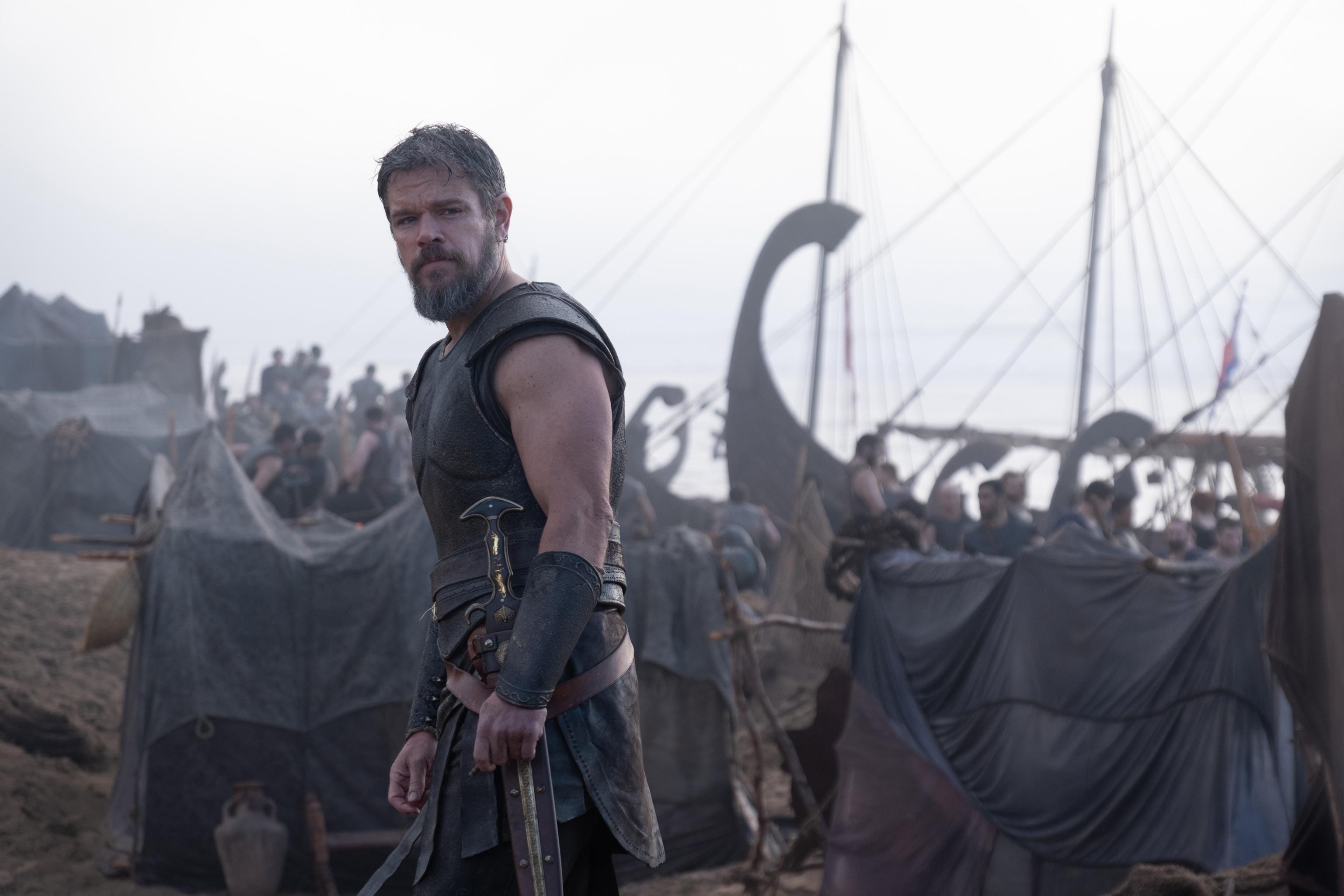

Christopher Nolan has a lot on his mind, huh?
I labelled Paul Thomas Anderson as a master of ‘Trojan horsing’ the personal into a masterfully crafted epic when he dropped One Battle After Another on us. Leave it to Nolan to not only one-up his fellow cinematic auteur by turning The Odyssey into the grandest home movie of all time, with one of our most fundamental pieces of literature as the basis, but also wrap it up with everything about the crumbling of modern society that stresses him out and packs it all in a literal Trojan horse.
For all of Hollywood’s unashamed IP milking, The Odyssey has somehow escaped that treatment. For good reason, how in the ancient Greek world do you even begin to adapt a story about a man’s journey back home where gods and monsters roam wild? Given how Nolan’s last movie, Oppenheimer, was about his anxieties filtered through the harnessing of god-like power via the atomic bomb, he is perhaps the only one who could’ve taken The Odyssey and invested it with so much personal meaning and a thematic richness that serves as a logical continuation of a near-unmatched career.
Within the first scenes of Travis Scott’s bard character weaving a tale of Odysseus (Matt Damon), an expectation is set. Whereas Oppenheimer (and Memento) alternate between coloured subjective POVs and black-and-white objective views, Nolan’s take on Homer’s epic is all in rich colour. The Odyssey is a fairytale, told differently depending on who you ask. Is Athena (Zendaya) an actual goddess? Did Circe really magic Odysseus’ men into pigs? Was there actually a Cyclops? Maybe. Maybe not. It’s all about the journey, which is why the use of modern English instead of ancient Greek works. The source material may be centuries old, but Nolan’s screenplay is modern in its sensibility and dialogue, which goes a long way in erasing any difficulty locking in with the Homer of it all. Besides, no one knows what the ancient Greeks actually sounded like.
Given how the source material uses flashbacks and non-linear storytelling, Nolan must’ve been rubbing his hands with glee, as that’s his cinematic calling card. He depicts Odysseus as an amnesiac struggling to remember his life as a seasoned adventurer. In retelling his memories to Calypso (Charlize Theron), Odysseus’ story is trickled out piece by piece through flashback, and his journey becomes part travelogue and part remembering the moral lines he abides by.
It’s interesting how Damon portrays Odysseus as an introspective and incredibly capable leader who earns his men’s respect through thinking rather than brawn or trickery. I’m not saying that Nolan views himself as a low-key yet commanding figure on the same level, but the projection of the responsibility he feels as perhaps the last remaining director who can command $250 million budgets to make whatever he wants that’s unshackled to IP is evident. Like how Odysseus is responsible for his men, kingdom, and family, Nolan devotes his full, undivided attention to every movie he makes because he has to make the most of the resources he’s been given.
He certainly doesn’t miss a beat on that front because The Odyssey is the culmination of everything Nolan has learned so far about epic filmmaking. Like how home movies attempt to capture everything within the frame, almost out of fear of missing something important, The Odyssey maximises its ‘IMAX cameras only’ approach by making every shot as grandiose as possible. From sweeping shots of the Trojan horse half-buried in sand while remnants of the Trojan War burn in the background to the painstaking recreation of a slowly crumbling Ithaca, Hoyte van Hoytema’s cinematography implores your eyes to soak up everything with a sense of awe on par with Lawrence of Arabia.
That aforementioned fear becomes increasingly evident as more pieces of Odysseus’ past fall into place. This is a man who is not only burdened with the responsibility of his men, his kingdom, and his family, but also the guilt resulting from the consequences of his actions. Odysseus and J. Robert Oppenheimer are basically the same Nolan-surrogate protagonists in their increasingly cynical view of the world, the former often invoking ‘Zeus’ Law’ of ancient Greek hospitality that’s eroding, and the latter realising how the world has hit a moral point of no return when the bombs he helped make were used on people. What role do gods ultimately play when these men can seemingly defy them through sheer force of will and intelligence?
Nolan certainly doesn’t believe that gods are all-powerful beings with abilities far beyond humanity’s capabilities. There’s a gritty, practical realism to the more fantastical and mythological elements of The Odyssey, almost like Nolan is stubbornly showing how humans can recreate the power of gods through their own devices. The many ship sequences look and feel visceral in a way CGI simply can’t replicate, with only the most fanciful moments being touched up with technology. The Cyclops Polyphemus (Bill Irwin) is clearly the product of puppetry, make-up, and clever camera trickery. Circe’s (Samantha Morton) magic is a stunning piece of on-screen mechanical transformation that makes you wonder how great practical effects can be when artists are left to do what they’re best at.
Running parallel to Nolan’s anxieties about the world and Hollywood is arguably his most personal movie yet. He’s never been shy about how important his family is to him, sometimes to a fault, such as his repeated use of the ‘dead wife’ trope and his lopsided love for his daughter over his son in Interstellar. The Odyssey feels like something of a course correction on both fronts. As Odysseus struggles to regain his memories, his wife, Penelope (Anne Hathaway), is fighting off a mob of self-interested men who want her hand in marriage as a way to seize the throne before their son, Telemachus (Tom Holland), comes of age.
In a world ruled by the patriarchy, Hathaway plays Penelope as a pragmatist doing her best in a bad situation. Within the limited scope of what she can actually do, Penelope still retains her agency, which rubs up against Telemachus’ youthful arrogance. Holland swaps out his occasionally annoying Marvel ‘aw shucks’ vibe for that of a troubled young man whose soul remains pure but whose patience is tested constantly by his mother’s endless suitors, particularly Antinous (Robert Pattinson).
Pattinson, clearly relishing his turn as a villain, imbues Antinous with a despicable cowardice that feels like the personification of everything that’s wrong in the world. If this floppy-haired, wine-drinking wimp marries Penelope, you know everything is going to go downhill fast, not unlike Oppenheimer handing over the atomic bomb to the US government.
As The Odyssey marches towards its thrilling conclusion, Odysseus’ journey and the movie’s thematic explorations culminate in a surprising feeling of regret. In the same way that One Battle After Another is a generation torch-passing moment, Nolan feels almost apologetic over how far society has fallen in the hands of greedy men wanting to grasp power and ruin everything, yet he retains hope that his children (and future generations) can learn from the past’s mistakes and do better.
Intentionally trying not to read too much before I watch it but your subtitle and rating deserve the like, and I will loop back after I see today :)