
Disclosure Day
Full disclosure, this is a great movie.


When you’re as accomplished a storyteller as Steven Spielberg, it’s hard to find an angle or genre that’s not been done before. Aliens? Check. Historical drama? Yep. Biopic about your formative childhood years that took decades to materialise? Tick. In all his creative detours, Spielberg has also been remarkably consistent at commenting on contemporary events, whether it’s through lessons from the past (Bridge of Spies and Schindler’s List) or a warning about the future (Minority Report and Ready Player One). So when Disclosure Day opens with a literal bang as two pro-wrestlers go at it hammer and tongs, it’s like a man who has seen far too much telling us that he’s got plenty more to say.
As we quickly find out, the wrestling match is merely a diversion because sitting in the crowd is Daniel Kellner (Josh O’Connor), a street-smart cybersecurity pro who is on the run. His crime? Stealing valuable evidence from Wardex (short for Waived Reporting, Development, and Extraction), a sinister non-government agency led by Noah Scanlon (Colin Firth) that’s up to some unsavoury business, namely the covering up of alien life-forms on Earth for decades and the horrible experiments conducted on these extra-terrestrials.
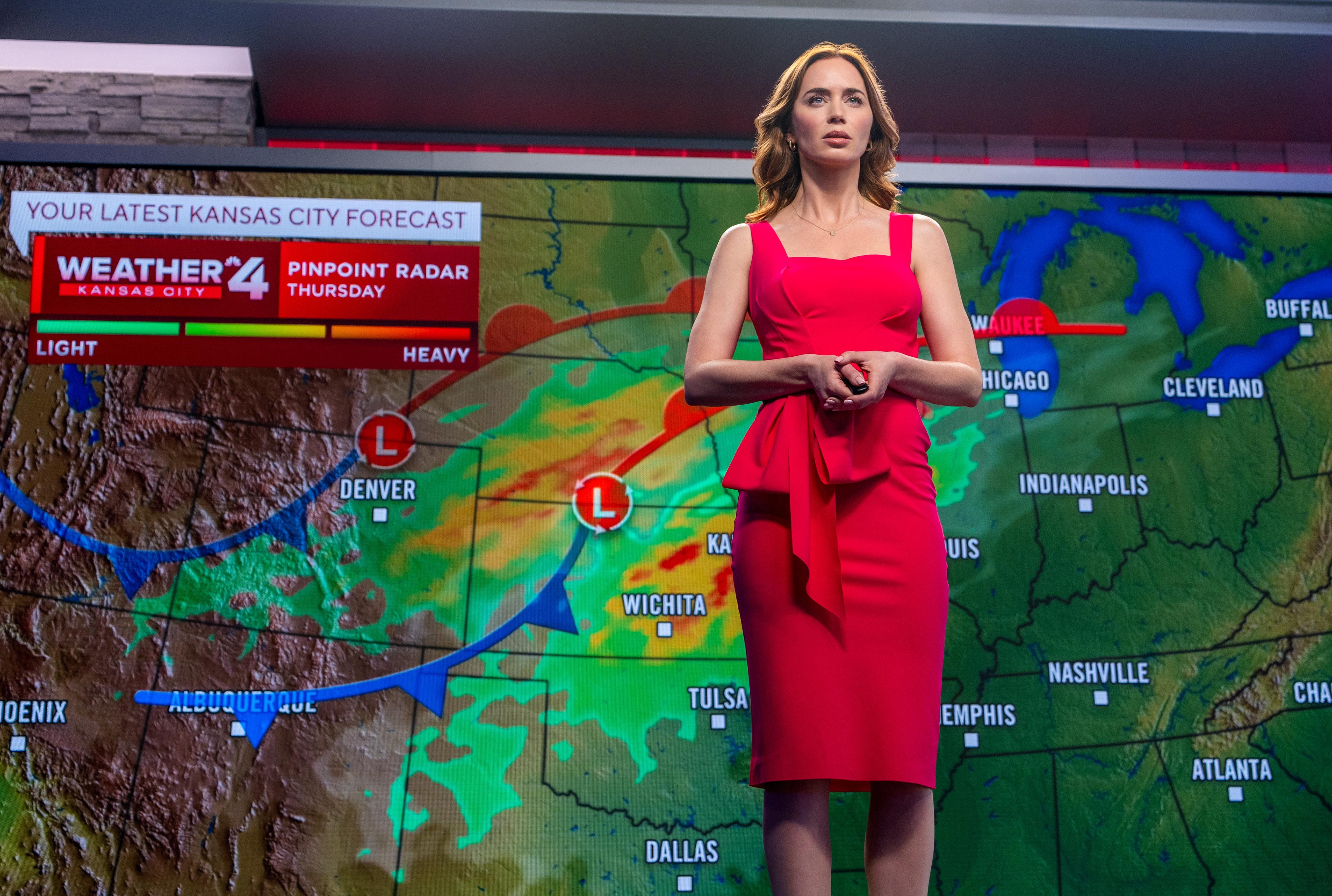
At the same time that Daniel goes on the run, Margaret Fairchild (Emily Blunt), a meteorologist with aspirations to be a lead anchor for a local news station in Kansas City, is having her own terrible, horrible, no good, very bad day. After suddenly speaking fluent Russian to her boyfriend, Jackson (Wyatt Russell, who plays weaponised incompetence so well), she uses her newfound mind-reading powers to talk her way out of a speeding ticket before going viral after sprouting a bizarre clicking language while live on-air. This quickly captures the attention of Noah and Wardex, and soon Margaret is also on the run.
Aliens may be a main subject in Disclosure Day, but they remain on the periphery. This is a low-key chase movie where escape is the name of the game, much in the vein of Duel and Catch Me If You Can, rather than the whimsical vibe of E.T. or the yearning for purpose of Close Encounters of the Third Kind. The movie is also far more interested in humanity than any extra-terrestrial visitors, as it navigates through an age of whistleblowing, misinformation, and government overreach far more literally than any previous Spielberg movie. “People are starved for the truth!” exclaims Hugo Wakefield (Colman Domingo), a fellow Wardex defector and Daniel’s de facto whistleblower boss, as subtext repeatedly becomes text in David Koepp’s weighty script.
Reveals are less important than the workmanlike plotting of Daniel and Margaret’s converging stories, resulting in a surprising lack of sentimentality compared to Spielberg’s usual metaphor-heavy approach. There’s no room in the script for hidden messages or morals, just a straightforward examination of how humanity would react if aliens were revealed to the world, and if people even have the attention span or critical thinking to properly process information of this magnitude.
Koepp’s script also struggles to find space for its characters to properly breathe outside of their trope-heavy depictions. Firth’s Scanlon is a moustache-twirling villain with one brief moment of humanisation that does far too much heavy lifting to be truly effective. Domingo’s Wakefield is clearly intended to be the yin to Scanlon’s yang, but he’s nothing more than an all-knowing type who is forever holding us at arm’s length. There’s simply not much to latch onto character-wise because no one behaves like a real person. Well, with the exception of Margaret.
In a performance that’s one of 2026’s best, Emily Blunt plays Margaret as someone who is always seemingly on the verge of a nervous breakdown but manages to hold it together through sheer willpower, all without sacrificing the character’s inner life. How else would you explain why she’s dating Jackson? This is encapsulated in a standout four-minute unbroken sequence where a frazzled Margaret arrives late to work. Without missing a beat, she’s absorbing weather information, helping out a colleague with her mind-reading powers, translating fluent Korean (despite not knowing the language), and getting camera-ready. It’s entertaining and revealing all at once, a truly stunning piece of technical and character-building work that showcases how well-conceived Margaret is and how good Blunt is at bringing her to life.
While Daniel is the less compelling of the two protagonists, casting O’Connor in the role is a stroke of genius as Spielberg takes the earnest leading man energy he showed as a man of faith in Wake Up Dead Man and transposes it to a skeptic in Disclosure Day. He is logical yet also retains faith in humanity, which leads to one of the movie’s more interesting detours into how disclosing the existence of aliens will shake the foundations of religion. As Daniel’s girlfriend, Jane (Eve Hewson), makes the case that showing people raised on supreme beings an actual supreme being will be too much, he simply replies with “sure they can.”
As wary and critical as he can be about those in power (like cycles of state violence in Munich, or political tomfoolery and abuse of power in Lincoln), Spielberg is forever an optimistic storyteller. He finds the best in people, even during the darkest of times, and he doesn’t pass judgement on anyone’s belief systems. What Disclosure Day lacks in heartstring tugs, it makes up for in hopefulness, which is what we need in abundance to overcome this era of distrust. Sure, it’s a bit on the nose when Wakefield literally says empathy is the most important thing humans have, and in the hands of anyone else, those pleas would be corny or ham-fisted. In Spielberg’s hands, though, it’s an earnest appeal that mostly works in spite of itself.
Like Paul Thomas Anderson’s craft in One Battle After Another, it’s almost redundant at this point to note Spielberg’s sheer mastery of the cinematic language. It’s like saying Roger Federer is good at tennis or Michael Jackson can sing well. Yet there are moments of visual storytelling where you can’t help but show your respect. During a tense long-take sequence where Daniel is trying to escape from Wardex agents, the camera captures the character’s anxiety of trying not to be found out as the framing simultaneously clearly lays out where everyone is and what his next move will be. It’s Spielberg setting up the puzzle pieces and letting the audience put it all together themselves.
As the various threads get pulled together into the masterful final 20 minutes, things become more chaotic as more parties become involved and the focus turns to the media industrial complex. It’s easy to call the fawning depictions of news broadcasting teams naive, especially with the utter collapse of impartial news platforms and channels going on right now. But having shown his belief in the importance of reporting in The Post, Spielberg’s reiterating the news’ importance in Disclosure Day feels more like a reminder of what we need than wishful thinking. At a time of misinformation and bad faith actors, this is an aspirational jolt needed for an industry that’s rotting from the inside.
When that final shot and word is uttered, Spielberg isn’t revealing the answers that he may (or may not) have. He’s simply telling us, ‘here’s where we are, go make something of it.’ We’re forced to reckon with what is happening right now rather than be given an easy out, which is a decision that will undoubtedly polarise audiences (one moviegoer literally said out loud “you can’t do that!” as soon as the credits started rolling).
It’s hard not to be cynical about the world and all that’s happening, yet it feels almost fitting that Steven Spielberg, the architect of so many cinematic ‘warm hug’ moments, is still the one imploring us to stay hopeful. When it feels like humanity as a collective has stopped believing and listening to each other, who better to punch through that barrier than a 79-year-old man who has mined his own trauma for decades in order to make us feel better about ourselves and the world at large? He’s made us all believe that aliens exist before, and now he’s trying to convince us not to give up. And you know what? He’s convinced me again with Disclosure Day.
https://shapeofcinema.substack.com/p/disclosure-day-2026?r=8dbojf&utm_medium=ios
I don’t think Spielberg made this film because there are no more genres left to be explored. I think he did it because he wanted to.